236
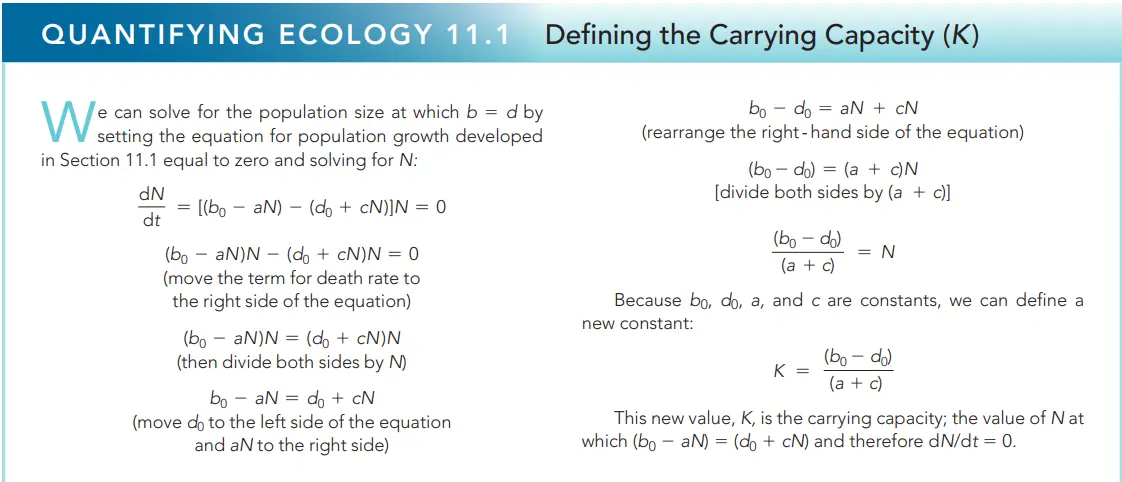
The pattern of population growth now differs from that of the original exponential model. As N increases, the birthrate (b0 − aN) declines, the death rate (d0 + cN) increases, and the result is a slowing of the rate of population growth. If the value of d exceeds that of b, population growth is negative, and population size declines (see Figure 11.1). When the birthrate (b) is equal to the death rate (d), the rate of population change is zero (dN/dt = 0). The value of population size at which the birthrate is equal to the death rate (b = d) represents the maximum sustainable population size under the prevailing environmental conditions. We can solve for this value by setting the equation for population growth equal to zero and solving for N (see Quantifying Ecology 11.1). The result is:
N= (b0 - d0)/(a + c)
Because b0, d0, a, and c are constants, this value of N represents a constant—a single value at which b = d and the population growth rate is zero (dN/dt = 0). We define this unique value of N as the carrying capacity represented by the letter K. The carrying capacity is the maximum sustainable population size for the prevailing environment. It is a function of the supply of resources (e.g., food, water, space, etc.).
We can now rewrite the equation for population growth that includes the rates of birth (b) and death (d) that vary with population size using the value of carrying capacity, K, defined previously:
dN/dt = rN ( 1 - N/K)