236
L'ambiente limita la crescita della popolazione
Il modello esponenziale non tiene conto che nella realtà le risorse non sono illimitate. Al crescere della popolazione cresce la sua densità e il consumo delle risorse. Se queste non si rinnovano allo stesso tasso con cui si consumano si ridurranno.
Una riduzione comporta una distribuzione ineguale di risorse, con conseguente aumento di tasso di mortalità, e riduzione del tasso di natalità.
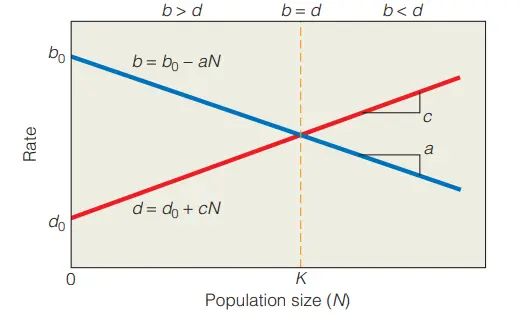
Questo grafico mostra due equazioni lineari per il tasso di mortalità e tasso di natalità in funzione della grandezza della popolazione. All'aumentare della popolazione il tasso di natalità e di mortalità diminuiscono e aumentano rispettivamente. La capacità portante è quella abbondanza per cui b = d, cioè la popolazione non cresce.
236
The pattern of population growth now differs from that of the original exponential model. As N increases, the birthrate (b0 − aN) declines, the death rate (d0 + cN) increases, and the result is a slowing of the rate of population growth. If the value of d exceeds that of b, population growth is negative, and population size declines (see Figure 11.1). When the birthrate (b) is equal to the death rate (d), the rate of population change is zero (dN/dt = 0). The value of population size at which the birthrate is equal to the death rate (b = d) represents the maximum sustainable population size under the prevailing environmental conditions. We can solve for this value by setting the equation for population growth equal to zero and solving for N (see Quantifying Ecology 11.1). The result is:
N= (b0 - d0)/(a + c)
Because b0, d0, a, and c are constants, this value of N represents a constant—a single value at which b = d and the population growth rate is zero (dN/dt = 0). We define this unique value of N as the carrying capacity represented by the letter K. The carrying capacity is the maximum sustainable population size for the prevailing environment. It is a function of the supply of resources (e.g., food, water, space, etc.).
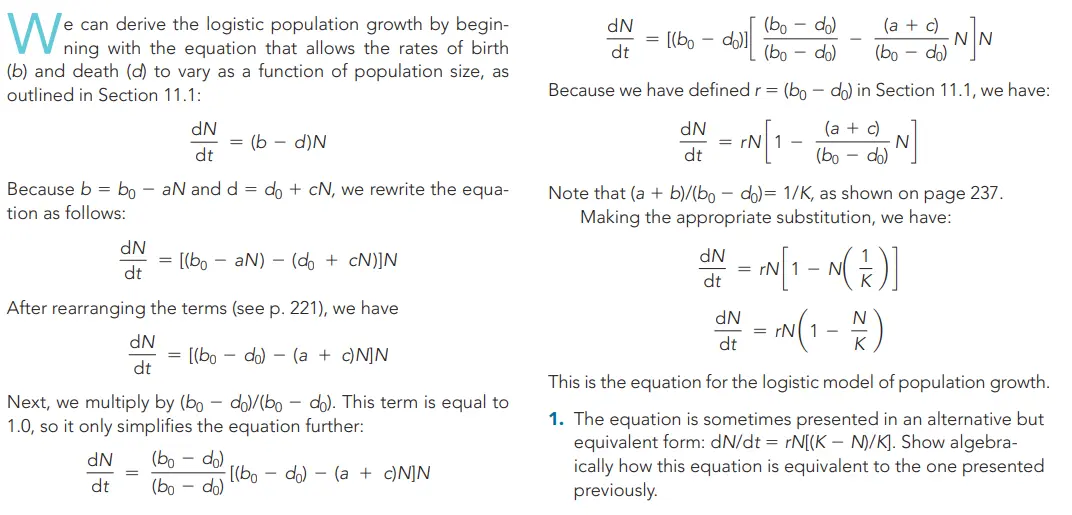
We can now rewrite the equation for population growth that includes the rates of birth (b) and death (d) that vary with population size using the value of carrying capacity, K, defined previously:
dN/dt = rN ( 1 - N/K)
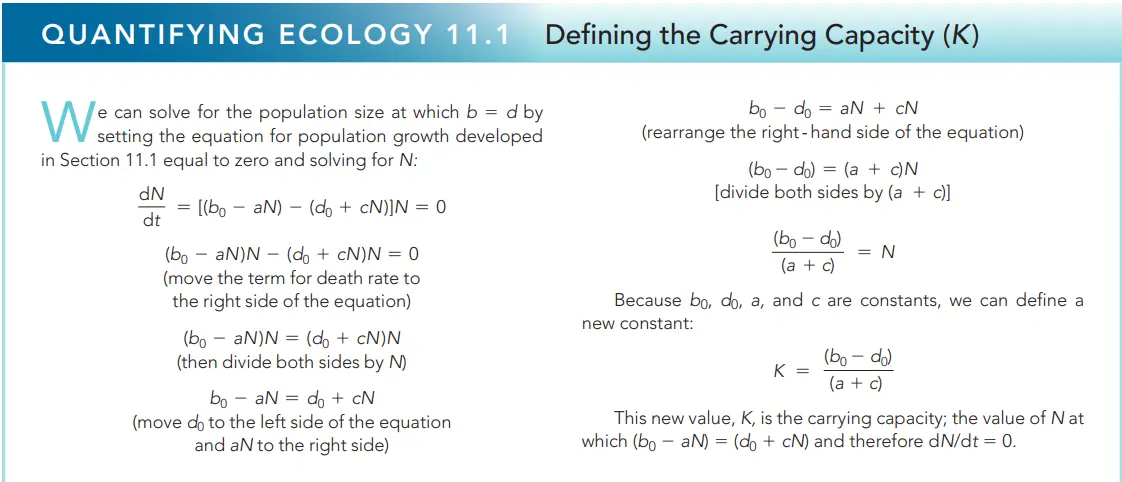
Possiamo riscrivere quindi (come vediamo sopra) la funzione della crescita di popolazione considerando le variazioni dei tassi di crescita e mortalità considerando K. Questo è chiamato il modello logistico
Il modello di crescita logistico tiene conto del limite che le risorse di un ambiente impone ad una popolazione. In natura non ci sono ecosistemi con risorse limitate, quindi le popolazioni incontreranno un plateau.
237
The logistic model effectively has two components: the original exponential term (rN) and a second term (1 − N/K) that functions to reduce population growth as the population size approaches the carrying capacity. When the population density (N) is low relative to the carrying capacity (K), the term (1 − N/K) is close to 1.0, and population growth follows the exponential model (rN). However, as the population grows and N approaches K, the term (1 − N/K) approaches zero, slowing population growth. Should the population density exceed K, population growth becomes negative and population density declines toward carrying capacity.
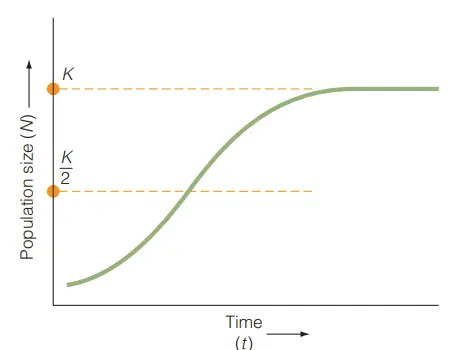
The graph of population size (N) through time for the logistic model is shown in Figure 11.2a. When the population is small, it increases rapidly but at a rate slightly lower than that predicted by the exponential model. The rate of population growth (dN/dt) is at its highest when N = K/2 (called the inflection point) and then decreases as it approaches the carrying capacity (K; Figure 11.2b). This is in contrast to the exponential model, in which the population growth rate increases linearly with population size.
Dipendenza dalla densità
238
Density-dependent effects influence a population in proportion to its size. They function to slow the rate of population growth with increasing population density by increasing the rate of mortality (termed density-dependent mortality), decreasing the rate of fecundity (density-dependent fecundity), or both. In the case of the logistic growth model, density dependent mortality and fecundity are incorporated by varying the rates of birth (b) and death (d), expressed through the value of the carrying capacity, K (Figure 11.4).
Mechanisms of density-dependent population regulation may include factors other than the direct effects of resource availability. For example, population density can influence patterns of predation or the spread of disease and parasites (see Chapters 14 and 15).
Other factors that can directly influence rates of birth and death function independently of population density. If some environmental factor such as adverse weather conditions affects the population regardless of the number of individuals, or if the proportion of individuals affected is the same at any density, then the influence is referred to as density independent.
Competizione
Implicito al concetto di capacità portante è il concetto di competizione. Avviene quando una risorsa comune si riduce e non è più sufficiente per tutti gli individui che la cercano.
Tasso di crescita
Nel caso di competizione, si può ridurre il tasso di crescita e sviluppo dei singoli individui. Ciò comporta una relazione inversamente proporzionale tra la densità di popolazione e lo sviluppo individuali. Ciò è riferito come crescita densità dipendente.
Dal libro
Mortalità
La competizione inoltre riduce il tasso di sopravvivenza. La mortalità però permette un aumento della disponibilità di risorse.
Dal libro
Fecondità
La competizione può infine influire sulla riproduzione e fecondità, ma ciò dipende molto dalla popolazione. Talvolta la fecondità dipende dalla taglia dell'individuo. Come abbiamo già visto lo sviluppo individuale può essere influenzato dalla competizione, perciò può influenzare anche la riproduzione.
Dal libro
Stress
Situazioni di competizione, cioè di alta densità e risorse limitate possono portare a più numerose interazioni negative inter- o intra- specifiche.